Modern work is an endless exercise in stakeholder management. The more important the work — the larger the number of people that must be consulted and convinced. You may be a product team considering a new price, a local government considering rolling out a new service or rolling back an old one. Someone inevitably has to figure out whether tens, or tens of millions of people will find it as acceptable as you do. This is how slide decks become national policy, or national news.
The advent of Language Models, large and small, has opened up the possibility of asking something with a natural language interface to think like and respond as your person of interest. This does not work.1
Even when fine-tuned for the task, the best language models fail to beat marginals or old-school statistical tools.2 That's why we built something entirely new on a novel architecture and unconventional training data. We call it Giedi 2.
Snowglobe is how the general public can actually interact with it. It's unlike any language model or chat bot that you've interacted with before. It's a full-scale simulation of the United States.
The free public version allows you to define a population, ask it a question, and explore its predicted responses. Far more powerful capabilities are available through customised enterprise deployments: larger synthetic samples, multimodal queries, one-on-one respondent interviews, finding where people like a particular respondent live using one of the world's largest OSINT datasets, and resolution down to congressional districts.
First, decide who you mean
How likely are Americans to seriously consider an electric vehicle the next time they buy a vehicle?
Let's find out. With Snowglobe, you can put it to the nation as a whole, or target a particular state. Numbers at geographic resolution are interesting, but they tend to obscure group-level disagreements. Snowglobe lets you examine this through Filter and
Break down by, both in the Parameters panel and both available in the free version:
- Break down by compares groups within the population you selected. Choose family income, for example, to see the income composition of each answer group.
- Filter changes the population being asked. Select an age range or income group and the estimate describes those people within your chosen geography.
When you hit the "Ask" button, thousands of synthetic people are being spun up and asked the question. Each of these synthetic people varies along the dimensions that regular people do. Enterprise deployments can sample larger populations of synthetic respondents, with sample sizes configured for your use case.
An intelligent classifier then groups the synthetic responses into broad categories. The response cards start with the topline — the predicted share for each answer — followed by a card for each position, with a featured synthetic response and, if you requested one, a demographic breakdown.
Snowglobe output
The next time you purchase a vehicle, how likely are you to seriously consider purchasing an electric vehicle?
Scroll or swipe for each position →
Nationally, 33.0% are very or somewhat likely to seriously consider an EV at their next purchase. Now use Filter to narrow the population to adults aged 18–29, and that share rises to 41.6% — a difference of 8.7 percentage points.
Snowglobe output
The next time you purchase a vehicle, how likely are you to seriously consider purchasing an electric vehicle?
Scroll or swipe for each position →
The Synthetic Pool

The thousands of synthetic respondents and their answers are available for you to explore. You can read each one of their responses. Each one of these synthetic people has their own traits that you can examine.
If you're an electric car manufacturer, you may want to find out if they perceive your very nice electric car to be a range-anxiety mobile or perhaps they're renters who can't install a charger at home. with a synthetic puts you in a one-on-one conversation with a synthetic respondent. This is especially useful if you're planning a large scale outreach campaign or an actual poll that costs hundreds of thousands of dollars to organise. Many a pollster's lakehouse mansion has been scuppered by poorly designed questionnaires.
Vox populi is not necessarily vox dei
Giedi 2 models how people speak as well as what they think: its respondents reflect the register of the demographic they represent. This can include language you would rather not hear at work. Giedi 2 is intentionally not safety-aligned — the training that teaches models like those in ChatGPT to avoid profanity and refuse certain requests can collapse the internal diversity of a model.
In the public version, a separate, safety-aligned model rewrites the responses to make them safe for work. Enterprise clients can speak directly to the raw respondent, with its original language and register intact.
We also use standard safety classifiers to restrict the topics you can ask about in the public version, and limit prompt length and the number of synthetic respondents sampled for each question.
Pinpoint
Sometimes, you find a respondent and want to know where people like them live. We've taken our SOTA LPM and connected it with one of the world's largest open-source intelligence (OSINT) datasets.
With , you can use this dataset to find out where people who resemble a given synthetic respondent live, opening up a much more sophisticated way to do market research.
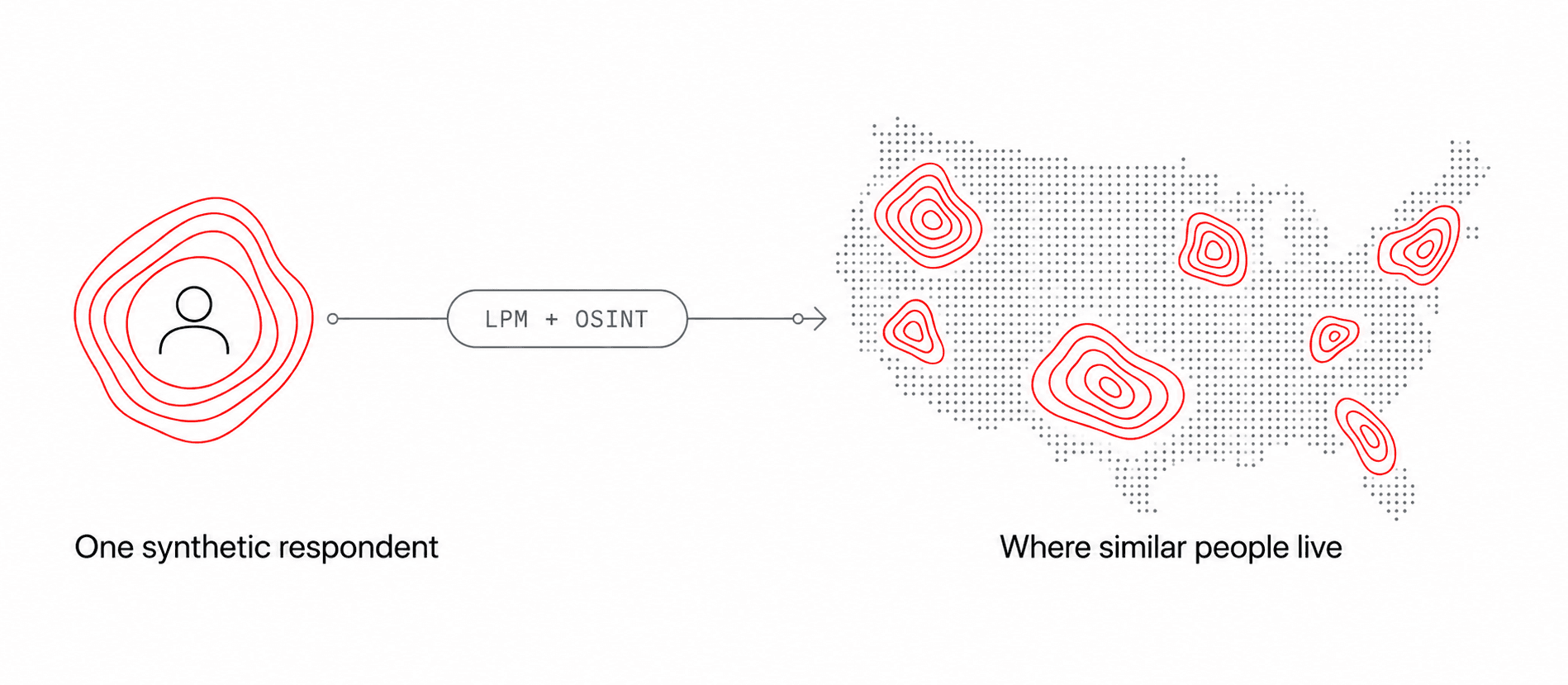
A closer view
While the public version allows you to go down to the state level, enterprise deployments can go down to congressional districts. In certain cases, we may be able to work with you to model specific regions, cities, towns or even a bespoke audience. Reach out to us at contact@aguilar.ai.
Let your audience see the thing
Sometimes, your question is not a question at all. Enterprise deployments can handle
, blending text, audio, images and video into the same query.
Enterprise deployments
Snowglobe
Public and enterprise
Capabilities configured around your audience
| Capability | Free public globe | Enterprise deployment |
|---|---|---|
| Pinpoint | Not included | Enterprise onlyHeat maps of where people resembling a respondent live, connecting our LPM with one of the world’s largest OSINT datasets |
| Multimodal queries | Not included | Enterprise onlyText, audio, images and video in the same query, with configuration and fine-tuning assessed for your use case |
| Respondent interviews | Not included | Enterprise onlyOne-on-one conversations with synthetic respondents |
| Bespoke audiences | Not included | Enterprise onlySpecific regions, cities, towns or bespoke audiences, by arrangement |
| Geographic resolution | National and state | ExpandedNational, state and down to congressional districts |
| Respondent language | Responses rewritten by a separate, safety-aligned model to make them safe for work | ExpandedDirect access to the raw respondent, with its original language and register intact |
| Synthetic sample | Thousands of respondents per question, with a per-question sample limit | ExpandedLarger samples configured for your use case |
| Results and synthetic pool | Predicted answer shares, grouped responses, individual answers and respondent traits | Predicted answer shares, grouped responses, individual answers and respondent traits |
| Population queries | Questions, filters and breakdowns | Questions, filters and breakdowns |
If you're interested in learning the empirical foundations of Snowglobe, we recommend looking at the Giedi 2 announcement and our open-sourced experiments and model weights in the Giedi Embedding blog post.
Or talk to us about a deployment of your own.
Footnotes
Footnotes
-
Several studies document the gap between adopting a persona and reproducing human responses. Bisbee et al. (2024), Synthetic Replacements for Human Survey Data? The Perils of Large Language Models, find that ChatGPT's persona-conditioned answers approximate survey averages while understating variation and misrepresenting relationships between characteristics and opinions; small prompt changes and model updates also alter the results. Taday Morocho et al. (2026), Assessing the Reliability of Persona-Conditioned LLMs as Synthetic Survey Respondents, find no consistent overall gain from demographic personas across two models, with some questions and subgroups becoming less accurate. Lutz et al. (2025), The Prompt Makes the Person(a), show that prompt formulation materially changes alignment and stereotyping, particularly for marginalised groups. Some prompting strategies help in these studies; the problem is treating a convincing persona as evidence of population fidelity.
-
These comparisons concern different tasks and should be read separately. Hu and Collier (2024), Quantifying the Persona Effect in LLM Simulations, find modest benefits from persona prompting on subjective annotation tasks, but their 70B model captures only 81% of the annotation variance achievable by a linear regression fitted to human labels. Moon et al. (2026, preprint), Beyond Averages: Evaluating LLMs on Human Survey Replication at the Distributional Level, find that none of ten models beats the pooled human marginal distribution for purchase-quantity distributions; several do beat it for brand choice. Chen, Zhu and Zheng (2026, preprint), When Synthetic Users Fail, find that all four tested models trail logistic regression on individual-answer accuracy in both the General Social Survey and World Values Survey. Fine-tuning is a separate comparison: Krsteski et al. (2026), Valid Survey Simulations with Limited Human Data, evaluate prompting and survey-specific fine-tuning on nutrition, economic and political survey questions. Uncorrected estimates remain substantially biased; reserving human responses for statistical correction is more effective than spending the entire budget on fine-tuning. These results establish failures in the evaluated settings, rather than a universal ranking of every language model on every survey task.