I want to share my experience of 9/11 — the terrorist attacks on the US that took place on September 11, 2001. It's not something I often talk about, but those times that I have done so, it seems to really interest people. Also, as that event is nearly 25 years ago, for those who were too young to remember it, or who were not yet born, it might serve to put into perspective the events of that day. Like other seminal events that changed the world, everyone who was old enough remembers where they were and how they experienced that fateful day.
Why me? Why does my experience matter? I was not one of those trapped inside one of the buildings that were struck by airplanes, and I didn't struggle to escape through smoke and falling rubble. I was not a first responder, nor was I in the immediate vicinity, and did not respond to assist others. Obviously, I was not on one of the hijacked aircraft and did not sacrifice myself to save others. Those are the true heroes of that day, and I am not one of them. However, I was then in the service of the United States, and did a small part to defend the country, as did many others that day and in the days and years that followed.
Tuesday, September 11, 2001, dawned clear and pleasant, as the red disk of the sun broke the horizon where the Atlantic Ocean met the sky. As Command Duty Officer (CDO) on the aircraft carrier USS John F. Kennedy (CV-67), I was up early to meet the day. Though I was not expecting it, this day turned out to be one I would never forget. Kennedy was pierside at our home port of Naval Station Mayport, Florida, outside of Jacksonville, where the St. John's River meets the ocean. It's an idyllic and tranquil spot, surrounded on three sides by water — the ocean, the river, and the intracoastal waterway that separates Florida's barrier islands from the mainland. It has beautiful white sand beaches, palm trees, and fishing boats that bring the day's catch to the historic village of Mayport that adjoins the base. I had been stationed there on two prior tours as a helicopter pilot in squadrons on the base, and though other assignments had taken me away, I kept returning to Mayport. As a Commander, this was my last assignment, my twilight tour of a 22-year Navy career, and my first on a carrier. That is rather unusual for a naval aviator; however, I flew helicopters — the SH-2F and SH60B — that deployed on surface combatants such as frigates and destroyers, escorting aircraft carriers and conducting anti-submarine missions. I had taken this assignment as a department head on the Kennedy to return to the Mayport area, and get my wife and two daughters back to the home they knew best in preparation for my retirement from the Navy.
As CDO in port, I was the senior officer on board during off-work hours, and was responsible to the Captain for the safety and operation of the ship and the well-being of the crew. While the ship was in port, the entire crew worked a regular eight-hour shift from Monday to Friday. After hours and on weekends, the crew was reduced to a duty section of personnel from each department to provide security, keep systems running, and be prepared for emergencies. Everyone on duty would report in the morning and would stay on the ship for 24 hours, sleeping and having their meals on board, just like we were at sea. The crew of an aircraft carrier is roughly 2000-2500 personnel, so even the duty section consisted of a significant number of people. Normally, the off-going and on-coming CDOs would turn over duty before 7 am. However, on this particular day, the JFK would be getting underway for two weeks to conduct training carrier qualifications; aviators in training would practice their first actual carrier landings to get their initial qualifications, a major step toward earning their wings. Since we would be leaving port a little later that morning, instead of being relieved as CDO, I remained on duty to assist in preparations to get underway.
As part of that responsibility, I walked off the ship to inspect the pier and make sure everything was in readiness to get underway prior to casting off lines. Having completed my walk on the pier, I embarked the ship at the hangar deck level, where I found the Executive Officer (XO) — the ship's second-in-command — Commander Zecchin and the Command Master Chief in animated discussion. When I joined the conversation to report that all was ready pierside, they told me that an airplane had hit the World Trade Center in New York City. Our discussion centered on the likelihood that it was a small civilian aircraft that accidentally hit the building while sightseeing, as had happened occasionally in NYC. However, as the news reports continued to come in, and we saw the videos on TV of the commercial airliners purposely crashing into the first and then the second tower, it was clear this was not an accident, that something much more serious was happening. Obviously, this distracted the entire crew, even while they undertook the myriad evolutions that had to happen to get a 1,000-foot-long, 80,000-ton ship away from the pier, out of the harbor, and safely to the open sea.
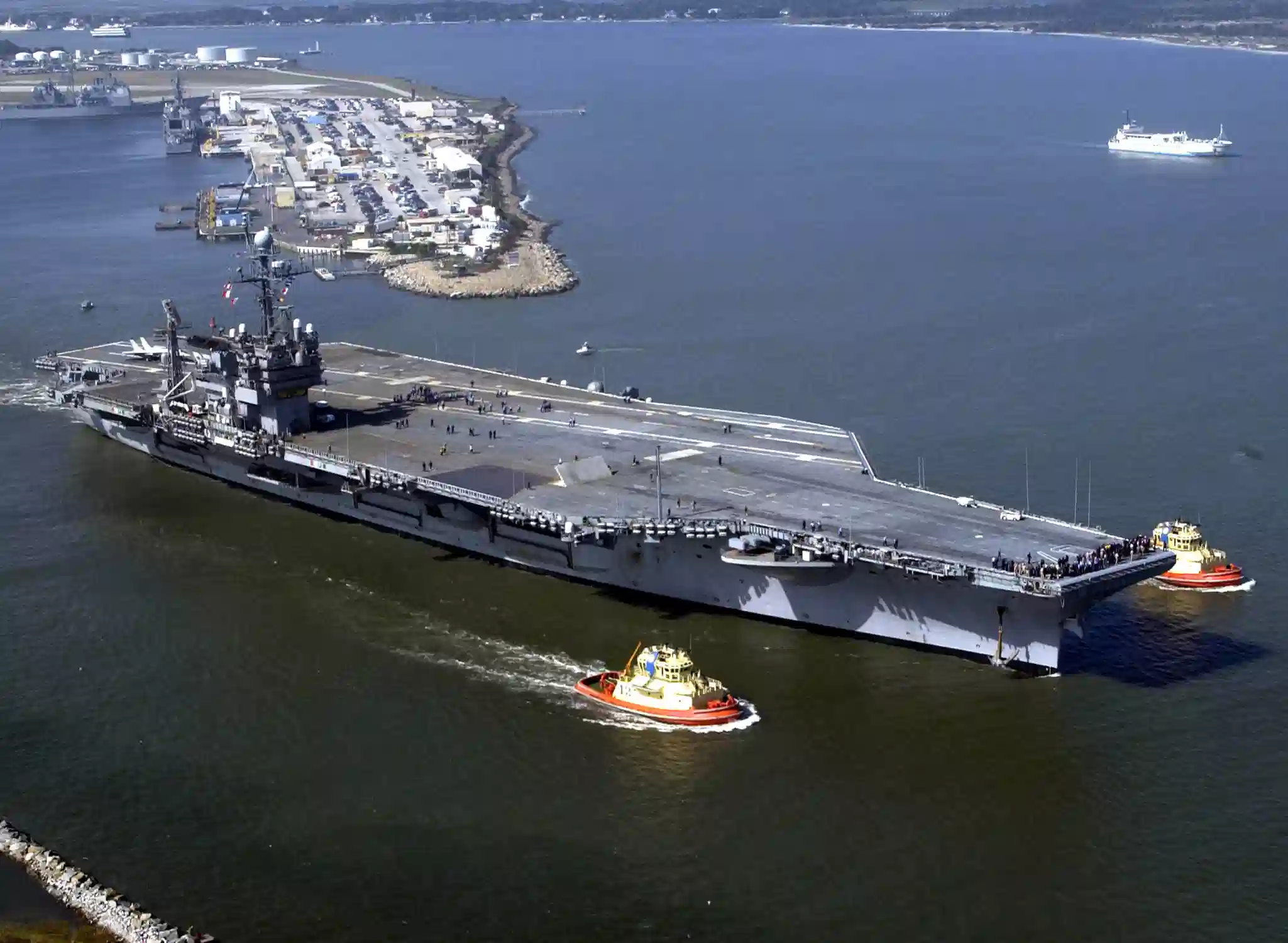
Mayport, Fla. (Nov. 11, 2003) — USS John F. Kennedy (CV-67) departs Naval Station Mayport under her own power following a ten month Extended Service Repair Availability (ESRA). During a short at sea period the ship tested numerous systems installed or upgraded while in port. The $300 million maintenance period included renovation of berthing compartments, and new navigational radar system. U.S. Navy photo by Photographer's Mate 1st Class Greg Curry
We did our best to focus on the task at hand, including getting Sailors to turn off their cell phones, while keeping an eye on the rapidly developing news. When the third hijacked aircraft hit the Pentagon, we knew the US was under attack. Without knowing when or if another blow would fall, or what the target might be, we were not taking any chances. We readied the ship's anti-aircraft defenses. With no fighter aircraft embarked, that consisted of RIM-7 Sea Sparrow short-range anti-aircraft missiles and Vulcan Phalanx Close-In Weapon System (CIWS, pronounced C-Whiz) automated 20mm cannon. We took the additional step of mounting Browning M2 .50 caliber machine guns at key points around the flight deck. Still wearing my CDO hat, I oversaw that evolution before standing down from duty with the XO.
Given the urgency and uncertainty of the situation, the carrier qualification training was summarily canceled. Instead of hosting a training squadron, we embarked two squadrons of F-18 Hornets to perform combat air patrols in an air defense role. Kennedy sailed north 700 miles to take up station off the Virginia Capes to protect the Norfolk Naval Base and Washington, DC. Other carriers from Norfolk sortied north to protect New York City. We established communication with the North American Aerospace Defense Command (NORAD) in Colorado Springs, CO and came under their operational control as part of the effort to protect North America from further attacks.
Fantastic Bunkers and Where to Find Them. Map by Aguilar.
According to the official Navy History and Heritage Command website, "John F. Kennedy and her battle group were ordered to support Operation Noble Eagle, set in motion in the wake of the brutal terrorist assault. The carrier and her consorts quickly established air security along the mid-Atlantic seaboard, including under its umbrella Washington, D.C., "to help calm a fearful and shocked nation." Simultaneously, George Washington and her battle group operated in the proximity of New York. "While John F. Kennedy Battle Group's services were needed for only a brief time," wrote one observer later, "every member of the Battle Group was proud of their role in Operation Noble Eagle providing security along the eastern seaboard of the United States."1
The 9/11 terrorist attacks impacted me not only because my country and people had been attacked, and because it was my job, as an officer in the Navy, to help protect them. It impacted me personally as well. Just two years earlier, I had been assigned to the Chief of Naval Operations staff in the Pentagon. The plane that hit that building struck in the very section where I had worked. Two of the people killed that day had been colleagues of mine. I did not know them well, but they worked just down the hall from me, in the Navy Command Center. Additionally, only a few months before, the Kennedy had participated in the annual New York City Fleet Week celebration that takes place each May. Not only did we spend a week enjoying the Big Apple's hospitality, but I had served as the ship's Fleet Week coordinator. The John F. Kennedy was a very popular vessel in New York due to its name, and the city always requested that she participate. Many other US Navy warships and ships from other navies also attended, but the carrier was the centerpiece of the celebration. There were many high-profile events attended by senior military brass and political VIPs. Beginning in January, I made numerous trips to NYC, working with the Navy's port liaison, a civilian official based in the city. We met with the Mayor's office, NYPD, FDNY, the USO, Port Authority, and the Intrepid Museum Foundation, among others.
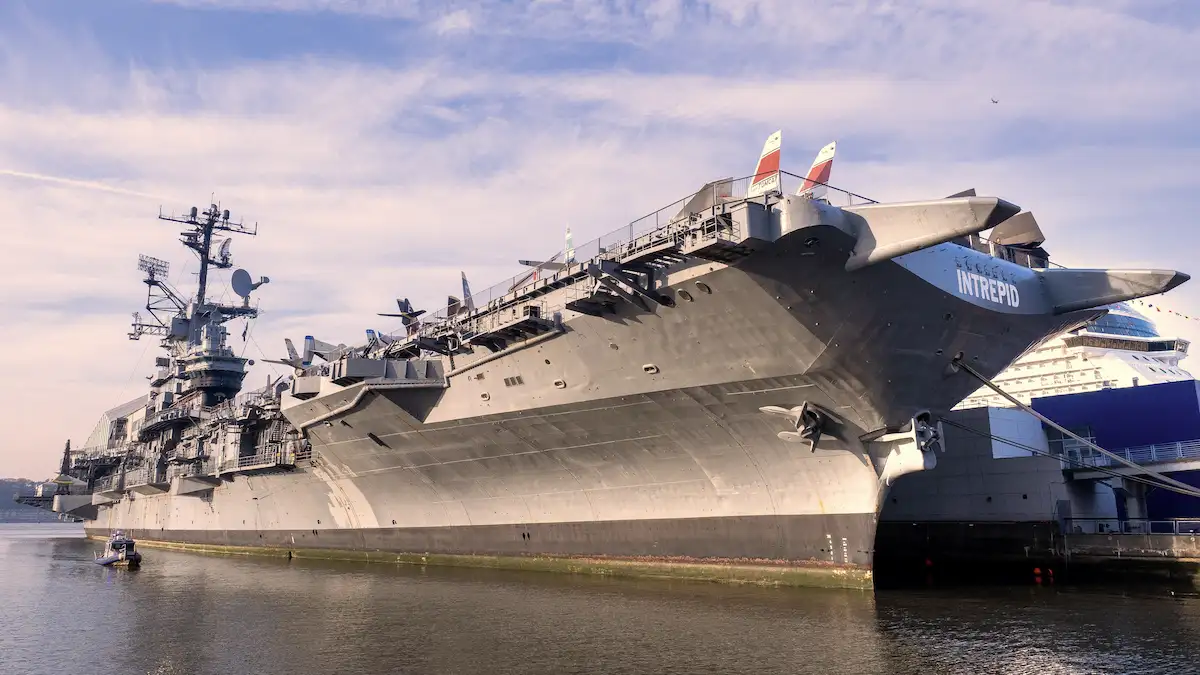
The Intrepid is a WWII aircraft carrier that is now a floating museum on the west side of Manhattan. Kennedy was berthed at the pier next to it. The museum hosts major tours and events as part of Fleet Week as well. Photo by Ajay Suresh.
On one of these visits, the city officials took me to see their new Emergency Command Center, which had recently been completed and of which they were quite proud. It had big video screens and computer stations for all the agencies that would be involved in responding to any kind of natural or man-made disaster. It was located on the 23rd floor of Tower 2 of the World Trade Center. In hindsight, the decision to locate it there was a poor one, especially in light of the failed bombing of the WTC in 1993. On another trip, I stayed in the Marriott Hotel in the WTC complex, located right between the main towers. I took the opportunity to visit the Windows on the World Restaurant on the 107th floor, with spectacular views of the night lights of three states laid out before my eyes. That evening, while having a drink at the bar, I met a gentleman who worked at a financial firm in the tower. We chatted a bit, and he gave me his business card. Unfortunately, I did not keep it, but I often wondered over the years what happened to him on that day, if he survived or not.
Fleet Week was a huge success. The City was incredibly welcoming, and they could not do enough for the Sailors. We were required to wear our summer white uniforms while on liberty, and it came with many benefits. Everyone wanted to meet us, take pictures with us, and buy us drinks. You can be sure that Sailors took full advantage of that! A friend and I visited the Empire State Building, and instead of standing in the unbelievably long line to go up to the observation deck, the manager gave us head-of-the-line privileges, so we went right up! Another event was a formal dinner on the Intrepid, with many VIPs in attendance, and Mayor Giuliani as the guest speaker.
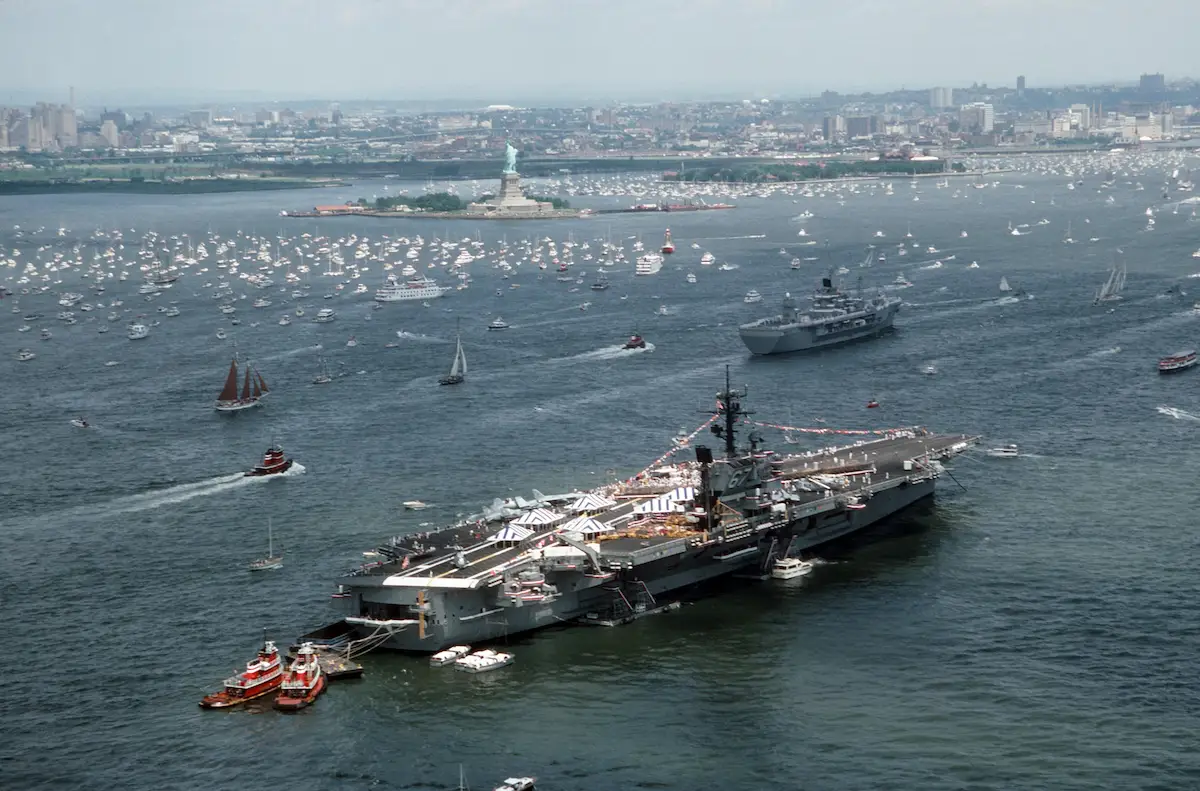
USS John F. Kennedy, CV 67, in New York Harbor for the Statue of Liberty Centennial. July 4, 1986
You can imagine that after being treated so well by the City and its people only a few months earlier, the tragedy of the 9/11 attacks hit the Kennedy crew particularly hard.
The US responded quickly to the attacks, and we soon had our part to play in defeating Al Qaeda and the Taliban.
"John F. Kennedy, with Carrier Air Wing 7 (CVW-7) embarked, deployed to the Persian Gulf, on 7 February 2002, two months ahead of schedule, in a battle group that included guided missile cruisers Vicksburg and Hue City, guided missile destroyer Roosevelt, destroyer Spruance, and guided missile frigates Underwood and Taylor. On 6 March, her battle group relieved Theodore Roosevelt's in the northern Arabian Sea, joining forces with John C. Stennis and her consorts, and the next day, transited the Strait of Bab El Mandeb, the southern entrance of the Red Sea."1
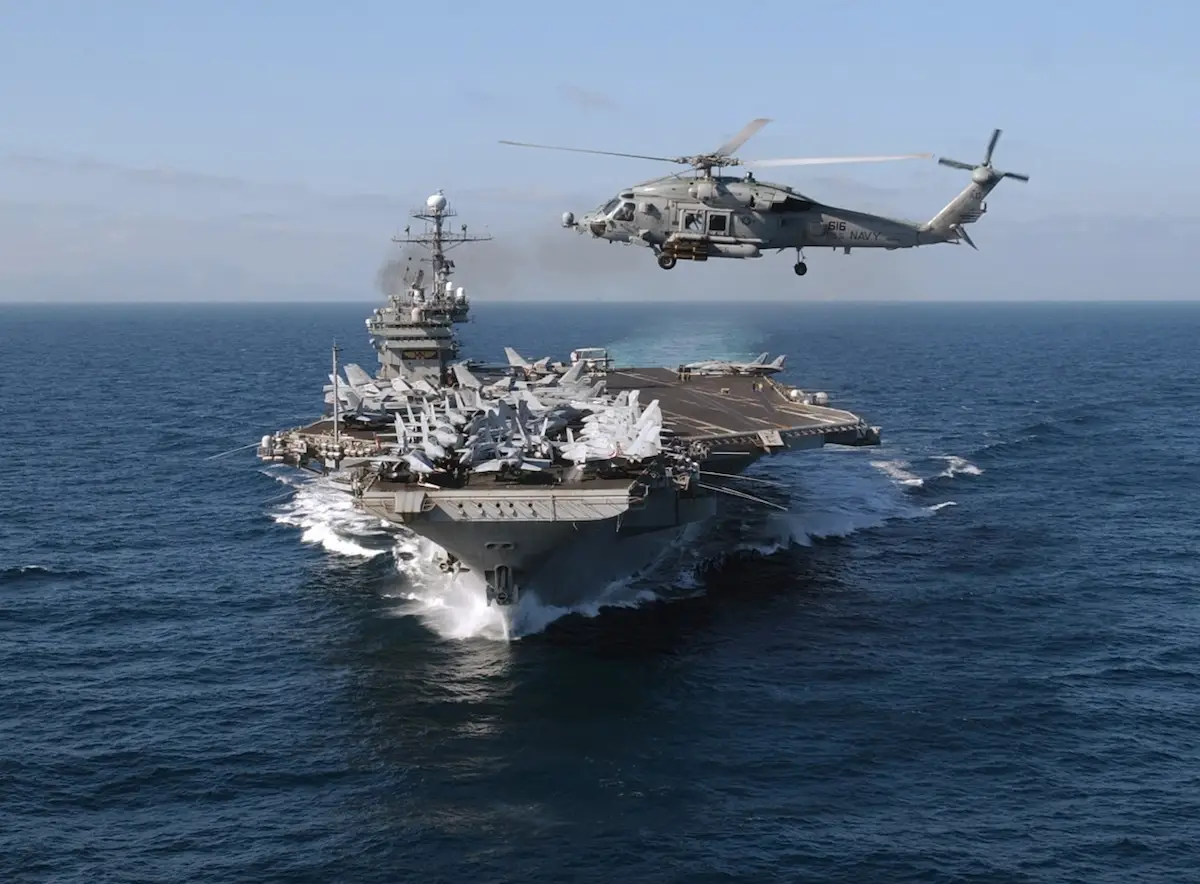
An HH-60H Seahawk helicopter assigned to the "Nightdippers" of Helicopter Anti-Submarine Squadron Five (HS-5) crosses the bow of John F. Kennedy as the carrier Battle Group (BG) arrived in the Mediterranean Sea. John F. Kennedy relieved Theodore Roosevelt (CVN-71), and conducted missions in support of Operation Enduring Freedom, 23 Februry 2002. U.S. Navy photo by Photographer's Mate 1st Class Jim Hampshire.
From the Arabian Sea and Persian Gulf we launched airstrikes and supporting sorties over Afghanistan in Operation Enduring Freedom. Flight operations went around the clock, time off station and port visits were few. Everyone worked at least 12 hours a day in a seemingly endless cycle of work, eat, workout, sleep, repeat. The ship's T-shirts for this combat cruise featured the phrase "the City That Never Sleeps, from Frank Sinatra's "New York, New York" in tribute to the city that had opened its arms to us during Fleet Week, and that suffered thousands killed during the attacks on the WTC. Truly, an aircraft carrier is a floating city of 5,000 people, including the embarked Air Wing, one that sails, operates aircraft, runs its power plant, and generates electricity around the clock, and serves 15,000 meals daily.
Kennedy's Commanding Officer, Captain R.L. Henderson addressed the crew just before launching the initial airstrikes on 10 March, 2002:
"We are currently proceeding, at best speed, to our launch point for tonight's strikes, off the coast of Pakistan, nearly 700 miles south of our targets in Afghanistan. At midnight, CVW-7 will launch into the dark night and strike their first blows of Operation Enduring Freedom, the war on terrorism. For us this is a culminating point in space, a culminating point in time, and a culminating point in history."1
The George Washington (CVN-73) Battle Group relieved John F. Kennedy and her consorts of their Enduring Freedom responsibilities on 19 July 2002. All told, John F. Kennedy had spent 129 days in theatre, conducting 97 Enduring Freedom fly days. CVW-7 averaged 76 sorties per day from 11 March through 17 July. A press release from the John F. Kennedy reported that CVW-7 dropped over 64,000 pounds of ordnance on Taliban and al Qaeda targets and supported U.S. and Coalition forces on the ground with close air support, on occasion working with Special Forces units. On 8 August, the carrier transited the Strait of Gibraltar, and returned to Mayport on 17 August 2002.1
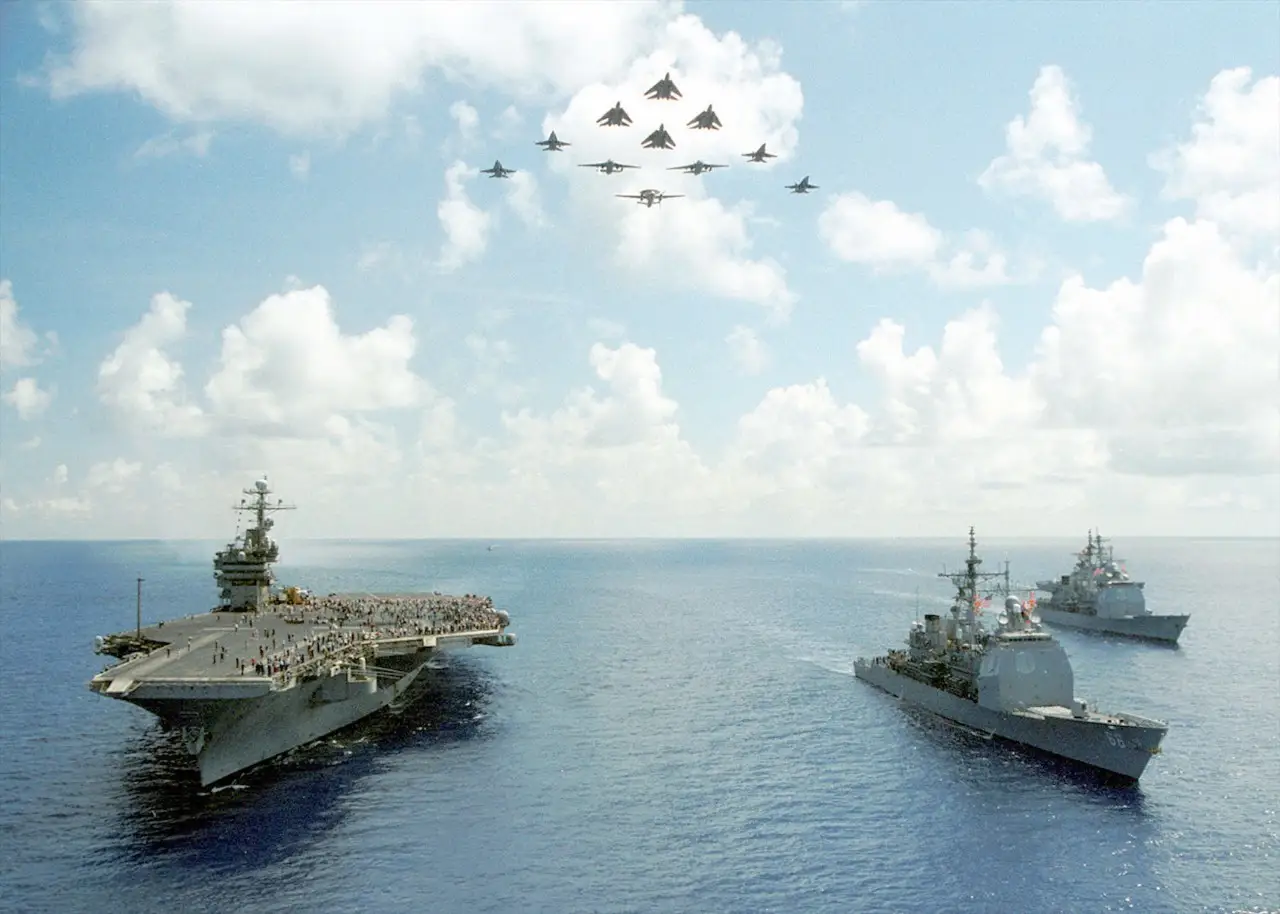
Carrier Air Wing Seven (CVW-7) performed a fly-over in formation along with John F. Kennedy (CV-67), Hue City (CG-66), Vicksburg (CG-69) and The Sullivans (DDG-68) to conclude an air show performance 16 August 2002. John F. Kennedy and CVW-7 were returning home after completing a six-month deployment conducting combat missions in support of Operation Enduring Freedom.
So that is my 9/11 story. Not one of heroism in a moment of crisis, but of dedicated service and of answering the call when needed. I retired from the Navy in March 2003. USS John F. Kennedy was decommissioned 4 years later, in March 2007. As the last conventionally-powered (non-nuclear) aircraft carrier, she was expensive to maintain, and the technology, especially of the engineering plant, was outdated. However, she gave her best when called upon, and I am proud of my service aboard and the role she played in service to our country. If you do not recall that tragic day, or if you were not aware of the military's initial response, or what the events meant to those of us in uniform, I hope this has helped to provide that perspective.
Prior to her decommissioning, Kennedy visited Boston for a farewell event in the city that was home to her namesake, the United States' 35th president. On 26 February 2007, John F. Kennedy set course for Boston, where she arrived to be welcomed "with open arms." Well over 60,000 people visited during that time, including members of the Kennedy family, who hosted a dinner on board on 2 March. Among the distinguished visitors were Senator Edward M. Kennedy, Senator John Kerry, Massachusetts Governor Deval Patrick, Chief of Naval Operations Admiral Michael Mullen, and Caroline Kennedy, John F. Kennedy's sponsor.1 Ultimately, on 23 March 2007, John F. Kennedy was decommissioned"with dignity and honor," and Capt. Zecchin relinquished command. On 26 July, John F. Kennedy set sail on her last voyage at the end of a tow line, setting course for the Philadelphia Naval Shipyard, which she reached on 1 August. John F. Kennedy was stricken from the Naval Vessel Register on 16 October 2009. She is laid up at Philadelphia pending final disposition.